
Please Share :


Rose-breasted Grosbeak
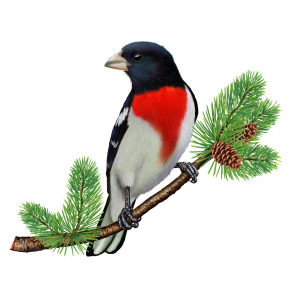
The Rose-breasted Grosbeak is a striking songbird native to North America, known for its bold coloration and melodious song. It belongs to the Cardinalidae family, which includes cardinals and buntings.
Identification & Physical Features
Males:
- Black head, back, and wings with white patches
- Bright rose-red patch on the breast
- Thick, ivory-colored beak
- White belly and underparts
Females:
- Brownish, heavily streaked with white
- Pale stripe above the eye
- Lacks the male’s red breast but shares the same thick beak
Size:
- Length: 7–8 inches (18–21 cm)
- Wingspan: 11–13 inches (28–33 cm)
- Weight: 1.2–1.7 ounces (35–49 g)
Habitat & Range
- Found in deciduous and mixed forests, woodland edges, parks, and gardens.
- Breeding Range: Eastern and central North America, from Canada to the northern United States.
- Migration: Winters in Central and South America, including Mexico, Venezuela, and the Caribbean.
Diet & Feeding Behavior
- Omnivorous: Eats seeds, fruits, berries, and insects.
- Frequently visits backyard bird feeders, preferring sunflower seeds.
- Uses its strong beak to crack open hard seeds and nuts.
Song & Calls
- Song: A rich, melodious tune similar to an American Robin, but sweeter and more refined.
- Call: A sharp, metallic “chink” sound, often heard in flight or when alarmed.
Breeding & Nesting
- Mating Season: Late spring to early summer.
- Nest: Built in trees or shrubs, made of twigs and grasses.
- Eggs: Usually 3–5 pale blue-green eggs with brown spots.
- Parental Care: Both parents share incubation and feeding duties.
Interesting Facts
- Male and female Rose-breasted Grosbeaks share incubation duties, which is uncommon among songbirds.
- They migrate at night, using the stars for navigation.
- Their bright colors and beautiful songs make them a favorite among birdwatchers.